
Table of Contents
- Why Shopfront Branding Regulations Matter
- Planning Permission for Shop Signs
- Advertisement Consent Requirements
- Listed Building Consent for Shopfronts
- Colour, Design, and Conservation Area Rules
- Step-by-Step Compliance Checklist
- Common Mistakes to Avoid
- Frequently Asked Questions
Last Updated: September 30, 2026
Why Shopfront Branding Regulations Matter
Shopfront branding regulations exist to protect your community’s character, safety, and heritage. They balance your right to advertise with the public’s right to live in well-maintained neighbourhoods. Breaking these rules can lead to costly enforcement action, fines, or forced removal of signage. Understanding what you need before you install anything saves time, money, and frustration.
Most business owners discover these rules after they’ve already ordered their signs. At Astral Coatings Ltd., we work with local property owners and shopkeepers across the region. Whether you’re refreshing a tired shopfront with professional spray finishing or installing new signage, you need to know what your local council requires.
The regulations differ depending on your location, the type of sign, and whether your property sits in a conservation area or is listed. This guide walks you through each requirement so you can plan with confidence.
Planning Permission for Shop Signs
Planning permission for shop signs depends on the sign’s size, illumination, and location. Many signs don’t need permission at all. Others require formal consent before installation.
Signs under 0.5 square metres that don’t obscure windows typically fall under “permitted development”, you can install them without applying. But once you exceed that size, or if your sign projects from the building or uses flashing lights, you’ll need to apply to your local council for planning permission.
The application process usually takes 8-13 weeks. You’ll submit drawings, photographs of the site, and details of materials and colours. Your council will assess whether the sign harms the area’s appearance or traffic safety. Approval isn’t guaranteed, especially in historic areas.
A common mistake is assuming all illuminated signs need permission. Some do, some don’t. Steady, non-animated lights are often permitted development. Flashing, chasing, or changing lights almost always require consent. Check with your local planning authority before you commit to a design.
Key points to verify with your council:
- Sign dimensions and projected area
- Whether it’s internally or externally illuminated
- Distance from the road and visibility from vehicles
- Whether your property is in a conservation area
Advertisement Consent Requirements
Advertisement consent is separate from planning permission. Even if your sign doesn’t need planning permission, it may need advertisement consent from your local council.
The Town and Country Planning (Control of Advertisements) Regulations 2007 govern this (The Town and Country Planning (Control of Advertisements) (England) Regulations 2007). Most shop signs fall within exemptions, meaning you don’t need to apply. But certain types, directional signs, illuminated fascias, or signs that obscure architectural features, require formal consent.
Your council’s planning department can tell you in minutes whether your specific sign needs consent. It’s worth asking before you design anything. The application is straightforward, but rejections can delay your project by weeks.
Signs that breach advertisement regulations can be removed at your expense. Councils have enforcement powers and will act if complaints arise. Prevention is far cheaper than removal.
Signs that typically need advertisement consent:
- Illuminated fascia signs covering more than 50% of the shopfront
- Projecting signs extending more than 1 metre from the building
- Signs on listed buildings or in conservation areas
- Directional signs pointing to off-site locations
Listed Building Consent for Shopfronts
If your building is listed, any external alteration, including signage, painting, or spray finishing, requires listed building consent. This is a separate process from planning permission and advertisement consent.
Listed building consent protects historic structures. Councils assess whether changes preserve or harm the building’s character and heritage value. Alterations that would be approved for ordinary buildings are often refused for listed properties.
The consent process typically takes 8-13 weeks. You’ll need detailed drawings, photographs, and material samples. Councils often require sympathetic colours, traditional materials, or designs that match the building’s age and style.
A critical mistake is starting work before consent is granted. Unauthorised works to listed buildings can result in enforcement action, fines, and orders to reinstate the original (gov.uk). The costs of remediation far exceed the cost of getting consent upfront.
If your shopfront needs refreshing, whether through professional spray coating or new signage, and your building is listed, consult your local conservation officer before proceeding. They can advise on acceptable approaches that meet both heritage and commercial needs.
Checklist for listed building consent:
- Contact your local planning authority’s conservation team
- Provide detailed photographs and drawings
- Specify materials, colours, and finishes
- Allow 8-13 weeks for determination
- Don’t start work until consent is issued
Colour, Design, and Conservation Area Rules
Conservation areas have stricter rules than ordinary neighbourhoods. Councils protect these areas’ character by controlling colours, materials, and design of shopfronts and signage.
Bright, garish colours are often refused in conservation areas. Councils prefer muted, traditional palettes that complement period architecture. If your building dates from the Victorian era, a heritage-appropriate colour scheme strengthens your consent application. Modern, high-contrast designs may clash with the area’s character.
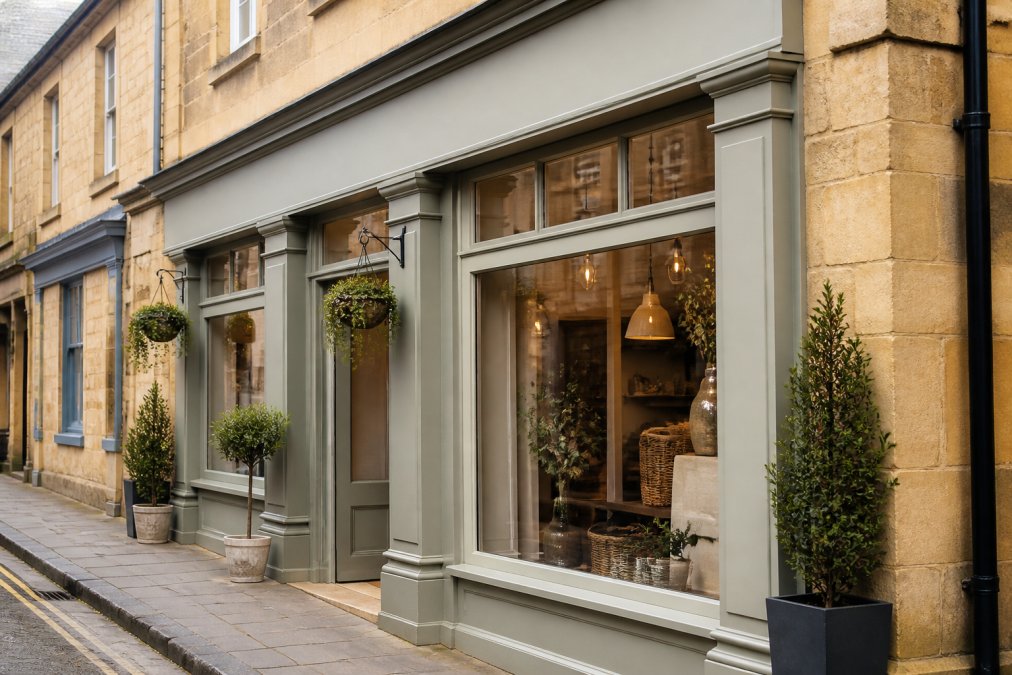
Maintaining the integrity of these heritage-sensitive palettes requires careful material selection, as preventing signage fading remains essential for preserving the long-term visual harmony of a protected streetscape.
Design standards vary by location. Some councils publish shopfront design guides specifying acceptable styles. Others assess applications case-by-case. Before choosing colours or materials, request your council’s design guidance, many publish free documents online.
The materials you use matter too. Plastic fascias are often refused in conservation areas; councils prefer timber or metal. If you’re refreshing a tired shopfront through professional spray finishing, using heritage-appropriate colours and finishes from the start ensures your application succeeds.
Conservation area considerations:
- Request your council’s shopfront design guide
- Choose colours from heritage palettes
- Use traditional materials where possible
- Avoid plastic or overly modern finishes
- Ensure signage complements, not dominates, the facade
Step-by-Step Compliance Checklist
Following these steps in order ensures you meet all regulations before installation.
Step 1: Identify your building’s status. Check whether your property is listed or in a conservation area. Your local council’s planning portal shows this instantly. If listed, you’ll need listed building consent for any external change. If in a conservation area, stricter design rules apply.
Step 2: Contact your local planning authority. Phone or email the planning department with details of your proposed sign or shopfront work. Describe size, materials, colours, and illumination. Ask whether planning permission, advertisement consent, or listed building consent is needed. Most councils answer this within days.
Step 3: Check your council’s design guidance. Many publish free shopfront design guides. These show acceptable colours, materials, and styles for your area. Using guidance from the start speeds up approval.
Step 4: Prepare your application. If consent is needed, gather photographs of your shopfront, detailed drawings of the proposed sign or finish, and material samples. Colour swatches are essential, show exactly what you plan to install.
Step 5: Submit your application. Use your council’s online planning portal or submit by post. Include all required documents. Pay the application fee if one applies. Keep proof of submission.
Step 6: Wait for determination. Most applications take 8-13 weeks. Your council will consult neighbours and assess whether your proposal harms the area. Check your application’s status online regularly.
Step 7: Respond to requests for information. Councils sometimes ask for clarification or additional details. Respond promptly, delays extend the determination period.
Step 8: Receive your decision. Approval, refusal, or conditional approval will be issued in writing. If approved, keep the decision letter. If refused, you can appeal or revise your proposal.
Step 9: Install your sign or finish. Only after you have written consent should you proceed. Ensure the installed work matches your approved plans exactly.
Step 10: Keep records. File your consent letter and approved drawings. These prove compliance if questions arise later.
Common Mistakes to Avoid
Installing signage or refreshing a shopfront without checking regulations first is the most costly error. Many business owners assume small signs need no consent, then face enforcement action.
Choosing colours without consulting your council’s design guidance wastes time. You design something you love, submit it, and it’s refused because it clashes with the conservation area’s character. Starting again delays your project by weeks.
Underestimating the application timeline causes problems too. Thinking you can install a sign in two weeks, then discovering the consent process takes 13 weeks, forces you to delay opening or rebranding.
Ignoring listed building status is serious. Working on a listed building without consent can trigger enforcement action and forced reinstatement at your expense.
Common pitfalls to sidestep:
- Don’t assume small signs need no consent
- Don’t choose colours before checking design guidance
- Don’t start work before written consent arrives
- Don’t ignore listed building or conservation area status
- Don’t use modern materials in heritage areas without checking first
Frequently Asked Questions
Do I need planning permission for a new shop sign?
Most small shop signs do not require planning permission under permitted development rules, provided they comply with size and installation standards. However, if your sign is unusually large, illuminated in certain ways, or your property is listed or in a conservation area, you will need consent. Check with your local planning authority before installation to confirm whether your specific shopfront branding requires planning permission.
What are the rules for illuminated shopfront signage?
Illuminated signs are subject to stricter regulations, particularly in conservation areas and on listed buildings. Most councils require advertisement consent for any illuminated signage. Internally lit box signs, neon, or LED displays typically need formal approval. Flashing or moving lights face additional restrictions. Contact your local authority’s planning department to confirm which lighting types are permitted for your shopfront branding.
How do I apply for advertisement consent?
Submit an application to your local planning authority with photographs of the proposed sign, technical drawings showing dimensions and materials, and details of installation. Include a site plan showing the shopfront’s location. Most councils charge a fee and respond within a set timeframe. Your local authority’s planning portal will have the specific application form and submission requirements for your area.
What happens if I install a shop sign without permission?
Installing signage without required consent is a breach of planning control. Your local authority can issue an enforcement notice requiring removal or alteration within a set timeframe. Non-compliance can result in prosecution and fines up to £20,000. Additionally, your business may face reputational damage and operational disruption. Always obtain the necessary consents before installation to avoid these risks.
Shopfront branding regulations protect your neighbourhood’s character whilst allowing legitimate business signage. Getting consent upfront prevents costly enforcement action, delays, and forced removal. At Astral Coatings Ltd., we help property owners and business operators navigate these rules when refreshing shopfronts through professional spray finishing. Contact us on WhatsApp to discuss how we can refresh your shopfront’s appearance whilst ensuring full compliance with local regulations.