Last Updated: November 15, 2026
Quick Summary
Choose exterior spray paint colours by assessing the surface and fixed elements first, then shortlisting tones that suit the property’s style. Test spray panels outdoors on the real material at the intended coat count, and check them at different times of day before committing.
- Walk the property and note material, condition, texture and fixed colours such as roof tiles and paving.
- Build a scheme from a quiet body colour, a trim one step lighter or darker, and one bold accent.
- Spray two coats on prepared panels and fix them to sunny and shaded spots for a week.
- Muted mid-tones age better than very pale whites on uPVC windows and damp elevations.
- Test your shortlist on the worst elevation, not the sunniest one.
Table of Contents
- Why Exterior Spray Paint Colour Choice Starts With the Property
- Matching Exterior Paint Colour Ideas to Your Home’s Style
- Building Exterior Colour Schemes for Houses That Hang Together
- How to Test Exterior Paint Colour Samples Outdoors
- Spray Painting uPVC Windows: Colour Choices That Hold Up
- How Spray Application, Substrate and Coats Change a Colour
- Weather, Exposure and Finish: Choosing Colour for the Long Run
- Planning Your Exterior Spray Colour Project With Astral Coatings
- Frequently Asked Questions
Why Exterior Spray Paint Colour Choice Starts With the Property
Choosing exterior spray paint colours is a decision about the building first and the paint second. The right colour for a tile-hung cottage is rarely the right colour for a modern brick house with dark grey frames, so the property itself comes first.
Paint is the cheapest thing you will change and the most visible. A colour that fights the brick, the roof or the neighbouring houses will look wrong no matter how well it is applied.
Assess the surface before you assess the colour
The surface decides which colours are even available to you. Fresh render, weathered uPVC, timber cladding and powder-coated aluminium all hold colour differently, and some take a narrower palette than others.
Walk the outside of the property and note:
- Material: brick, render, timber, uPVC, metal or composite
- Condition: chalky, faded, cracked, stained or sound
- Texture: smooth panels hide marks, rough render shows every shadow
Those fixed colours are your anchor. A colour that clashes with the roof will clash forever, so it helps to pick the palette around what stays.
Matching Exterior Paint Colour Ideas to Your Home’s Style
Style narrows the shortlist faster than any trend list, but it should not be treated as a set of costume changes. A period cottage, a 1930s semi and a new-build all carry different expectations, and buyers notice when a house ignores its own architecture.
Start with these pairings as a working shortlist, not a rulebook:
- Cottage or period: soft greens, off-whites, muted blues and heritage creams, usually with a deeper trim colour drawn from the roof or brick
- 1930s semi: warm whites, sage and putty tones with darker trim; avoid brilliant white, which reads harsh against older brick
- Modern new-build: charcoal, anthracite, slate grey and crisp white, often with a single darker accent on the front door
For exterior paint colour ideas, look at houses of the same age and construction within a few streets. Local precedent is free research, and it tells you what the light and surroundings already support.
Turning style into a sprayable shortlist
A style label is only useful if it survives the spray gun. Work through this sequence before you buy any paint:
- Identify the dominant architectural feature, brick, render, cladding or tile-hanging, and let that feature set the body colour.
- Pick the body colour from the quiet end of the style palette and check it against the roof and paving in daylight.
- Choose the trim one step lighter or darker than the body, not a separate colour family.
- Reserve the bold choice for the accent, the front door, a gate or a small detail, where a strong colour can be replaced cheaply if it disappoints.
- Confirm the finish is available in the spray system you intend to use, because some very flat or very bright colours are harder to build up evenly.
Watch out: a colour that looks right on a neighbouring rendered house can look wrong on your brick, because brick absorbs light differently and shifts the apparent tone. Always test on your own substrate.
Style constraints that are not about taste
Some style decisions are actually regulatory. If the property is listed, in a conservation area, or subject to a local authority Article 4 direction, exterior colour and materials may be restricted. Check with the local planning authority before committing to a colour, especially for front elevations and street-facing details. Even where no formal consent is needed, a scheme that ignores the terrace or street can look out of place and may affect resale.
Building Exterior Colour Schemes for Houses That Hang Together
A scheme is three colours working as one: the main body, the trim and the accent. Most disappointing exteriors fail here, not at the paint tin.
A workable split is:
- Body: the largest area, usually the quietest tone
- Trim: windows, doors, fascias and sills, often one step lighter or darker
- Accent: the front door or a small detail, where you can be bolder
Exterior colour schemes for houses work best when the accent is the only loud voice. Paint the front door a deep colour and keep everything else calm, and the house looks considered. Paint the body, trim and door three different strong colours and it looks like a mistake.
How to Test Exterior Paint Colour Samples Outdoors
Exterior paint colour samples must be tested outside, on the actual surface, in the actual light. A colour that looks perfect on a paper swatch can turn grey, green or flat once it is on a north-facing wall in February.
A practical testing workflow for spray finishes
Spray application changes how a colour reads, so test the way it will be applied:
- Prepare small panels of the same material, cleaned and primed as the real job would be
- Spray two coats at the intended thickness, not one thick coat
- Fix panels to the wall in at least two spots, one sunny and one shaded
- Check at three times of day: morning, midday and late afternoon
- Live with them for a week before deciding
- Compare against the fixed elements: roof, brick, paving and neighbouring walls
Before committing, you can visualise the finished colour on your property to see how a shortlist reads at full scale. It is a cheap way to rule options out before any paint is mixed.
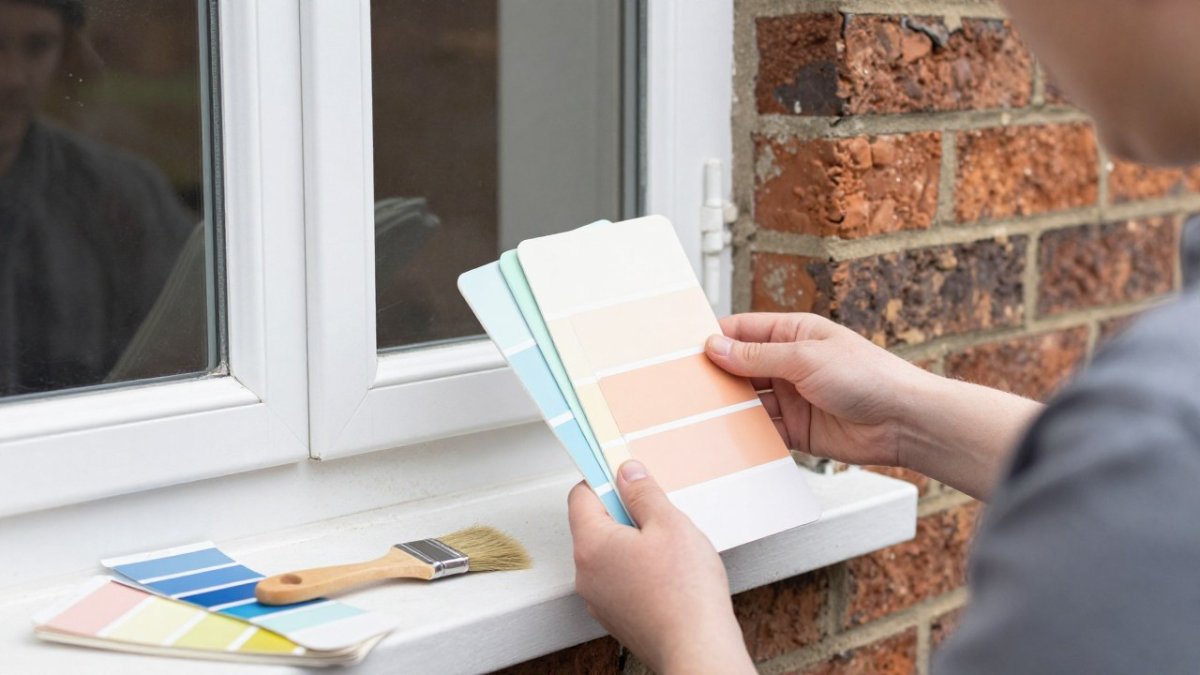
Testing a spray colour properly follows a fixed sequence rather than a single glance at a swatch.
| Step | What to do |
|---|---|
| 1 | Prepare small panels of the same material, cleaned and primed |
| 2 | Spray two coats at the intended thickness |
| 3 | Fix panels to the wall, one sunny and one shaded |
| 4 | Check at morning, midday and late afternoon |
| 5 | Live with them for a week before deciding |
| 6 | Compare against roof, brick, paving and neighbouring walls |
Spray Painting uPVC Windows: Colour Choices That Hold Up
Spray painting uPVC windows can open up colours the original frames never offered. The catch is that uPVC is smooth and non-porous, so the colour sits on the surface and every flaw in preparation shows through.
Choose with these points in mind:
- Muted and mid-tones age better than very pale whites, which show dirt first
- Dark greys and anthracites suit modern frames and hide weathering
- Strong colours work on doors and accents, less so across a whole elevation
If you are weighing up options, our uPVC exteriors service sets out what can be sprayed and how the finish is built up. For the full method, read our step-by-step uPVC spraying guide before you commit to a colour.
How Spray Application, Substrate and Coats Change a Colour
The same tin of paint can produce three different colours on three different surfaces. Spray application lays down a thinner, more even film than a brush, and that changes how light bounces off the finish.
Three factors move the result:
- Substrate: porous render drinks paint and dulls it; smooth uPVC holds it bright
- Coat count: two even coats give depth and consistency, one coat looks patchy
- Finish: matt absorbs light and softens a colour, satin reflects it and lifts it
This is why a colour matched from a swatch can arrive slightly darker or lighter on the wall. Testing on the real material, at the real coat count, reduces the surprise.
Weather, Exposure and Finish: Choosing Colour for the Long Run
Weather resistance and fade resistance are colour decisions as much as product decisions, and in a wet, temperate climate the exposure pattern of each elevation matters more than the colour trend of the moment. Strong sunlight bleaches organic pigments faster than mineral ones, a south-facing elevation will always fade before a shaded one, and a north-facing wall that never dries will show algae and dirt long before it shows fade.
Plan for the climate you actually have:
- Sun-facing walls suit earth tones and mid-greys that fade gracefully; very saturated reds and blues are the first to look tired
- Shaded, damp walls show green algae quickly, so mid-tones hide it better than white or very pale cream
- Coastal exposure punishes cheap finishes, so prioritise UV protection and a finish that sheds salt and moisture
How British exposure changes a sprayed colour over time
The colour you choose is only half the story; the other half is how the film behaves when it is wet for long periods.
A practical way to choose is to rank each elevation by exposure before you rank colours:
- South and west elevations, highest sun and driving rain; choose mid-tones with good UV stability and avoid very dark colours that show every mark and heat up more.
- North and east elevations, slowest to dry; choose mid-tones that mask algae and confirm the primer is suitable for the substrate.
- Sheltered courtyards and recesses, lowest air movement; expect dirt retention and choose a finish that can be cleaned without dulling.
- Coastal or elevated sites, salt and wind; prioritise the coating system’s exposure rating over the exact shade.
Watch out: choosing a colour because it looks good on a sunny day and ignoring how it performs on the damp side of the house is the most common way an exterior scheme disappoints.
Whatever colour you pick, the finish underneath decides how long it lasts. You can review the warranty and aftercare terms that sit behind a professional spray finish before you choose.
Planning Your Exterior Spray Colour Project With Astral Coatings
A colour scheme only works if the application matches it. A three-step spraying process, covering surface preparation, spray application and coat build-up, is part of how the work is planned.
Here is how we would plan it:
- Survey the surfaces and confirm what can be sprayed
- Shortlist colours against the fixed elements and the property’s style
- Test panels outdoors in the intended finish and coat count
If you want to know who will be on the job, you can read more about our team and background before getting in touch.
The hardest part of exterior colour is not picking a favourite, it is picking one that survives the surface, the light and the weather.
Frequently Asked Questions
How do I choose a colour for exterior spray painting?
Start with the fixed elements you cannot change: brick, stone, roof tiles and paving. Pick your exterior spray paint colour to sit alongside those rather than fight them. Then factor in the property’s style, the direction the main façade faces, and how much natural light the surface receives. Test a painted panel outdoors for several days before committing, because colours shift dramatically between a swatch under indoor light and a full wall in daylight.
How can I test an exterior paint colour before applying it?
Paint a small panel or offcut of the same material, not paper, and fix it to the surface you plan to coat. Leave it for at least three days so you see it in morning, midday and evening light, plus wet weather if possible. Check it from the pavement as well as up close. For spray finishes, ask for the test to be applied by spray rather than brush, since the sheen and texture differ.
Which exterior colours work best with white uPVC windows?
White frames are the most forgiving starting point. Warm greys, sage and muted greens, soft off-whites and deep navy or charcoal all sit comfortably beside white without clashing. Avoid very yellow-based creams, which can make white frames look grubby by comparison. If you are spray painting uPVC windows themselves, a satin or low-sheen finish in a mid-tone hides weathering better than a high-gloss white.
Does exterior spray paint look different in sunlight?
Yes, noticeably. Strong sunlight lifts lighter colours and can make dark ones look flatter than expected, while north-facing walls stay cooler and greyer all day. A colour that looks rich on a sunny south-facing door may read almost black on a shaded elevation. Always test on the actual elevation and check the colour at the time of day you will see it most.
