Tag: how to clean spray painted kitchen cabinets

  • Kitchen Cabinet Spray Painting: How Long It Really Lasts

    Kitchen Cabinet Spray Painting: How Long It Really Lasts

    Last Updated: November 2, 2026

    Quick Summary

    Professional cabinet spray painting can last many years, but the true lifespan depends on preparation, coating quality and daily wear. Treat any specific figure as a realistic guide rather than a promise, because a sprayed finish lasts only as long as the preparation underneath it deserves.

    • Spraying over grease that looks clean causes the finish to lift at the edges within a season.
    • Sprayed finishes are touch-dry within two to four hours but need five to seven days to cure fully.
    • Refit doors and drawers typically 24 to 48 hours after spraying, once the film has hardened.
    • Clean spray-painted cabinets with a soft cloth, warm water and mild washing-up liquid, then dry.
    • Peeling at edges usually means poor degreasing or a missing primer, so sand back, re-prime and re-spray.

    Table of Contents

    How Long Does Kitchen Respray Last?

    Most professionally spray-painted kitchen cabinets stay in good condition for many years, depending on preparation, coating quality and daily wear. Treat any specific lifespan figure as a realistic guide rather than a promise.

    Here at Astral Coatings Ltd., we’ve spent over 30 years in interior and exterior decorating, and the honest answer to “does kitchen cabinet spray painting last?” is this: it lasts as long as the preparation underneath it deserves.

    A sprayed finish is only as good as the surface it sits on. Degrease badly, skip the primer, spray over old grease near the hob, and you’ll see peeling within a couple of years. Do the prep properly and the finish can outlast the kitchen’s first owner.

    Below, we’ll walk through what actually drives lifespan, how our three-step process differs from a quick spray job, and how to spot and fix the failures that do happen.

    What Affects How Long Cabinet Spray Painting Lasts

    Durability isn’t one thing. It’s a stack of factors, and the weakest one sets the ceiling. A Houzz discussion on cabinet paint longevity makes the point plainly: even when cabinets are degreased, sanded and primed, how long the finish lasts depends on how the kitchen is used and abused.

    Three factors matter most.

    Surface Preparation and Condition

    Preparation is the biggest single lever, and it’s where cheap jobs cut corners.

    • Degreasing: kitchen grease sits deep in the grain and in every crevice. Miss it and the coating can’t bond.
    • Sanding: a keyed surface gives the primer something to grip.
    • Primer: the right primer blocks stains and gives the topcoat a stable base.
    • Cabinet condition: sound boxes and doors take a respray well. Swollen, delaminating or water-damaged units need repair first.

    Coating and Paint Quality

    The coating does the hard work.

    Film thickness matters as much as the product. Too thin and it wears through at the edges. Too thick and it can crack.

    Everyday Use and Wear

    Two kitchens with identical finishes age differently. A busy family kitchen with a steamy hob nearby wears faster than a lightly used one. Doors under a boiling kettle, drawers opened dozens of times a day, and cleaning with harsh chemicals all shorten the finish’s life.

    Kitchen Cabinet Spray Painting Preparation: The Step-by-Step Guide

    Good preparation follows a clear sequence. Rushing any step shows up months later as peeling, chipping or a patchy finish. For a practical walkthrough of modernising dated kitchen units, follow our step-by-step guide.

    The preparation sequence:

    1. Remove doors, drawers and hardware, and label everything
    2. Degrease every surface with a suitable cleaner, paying attention to areas near the hob
    3. Repair dents, cracks and loose edges
    4. Sand to key the surface
    5. Fill and sand again where needed
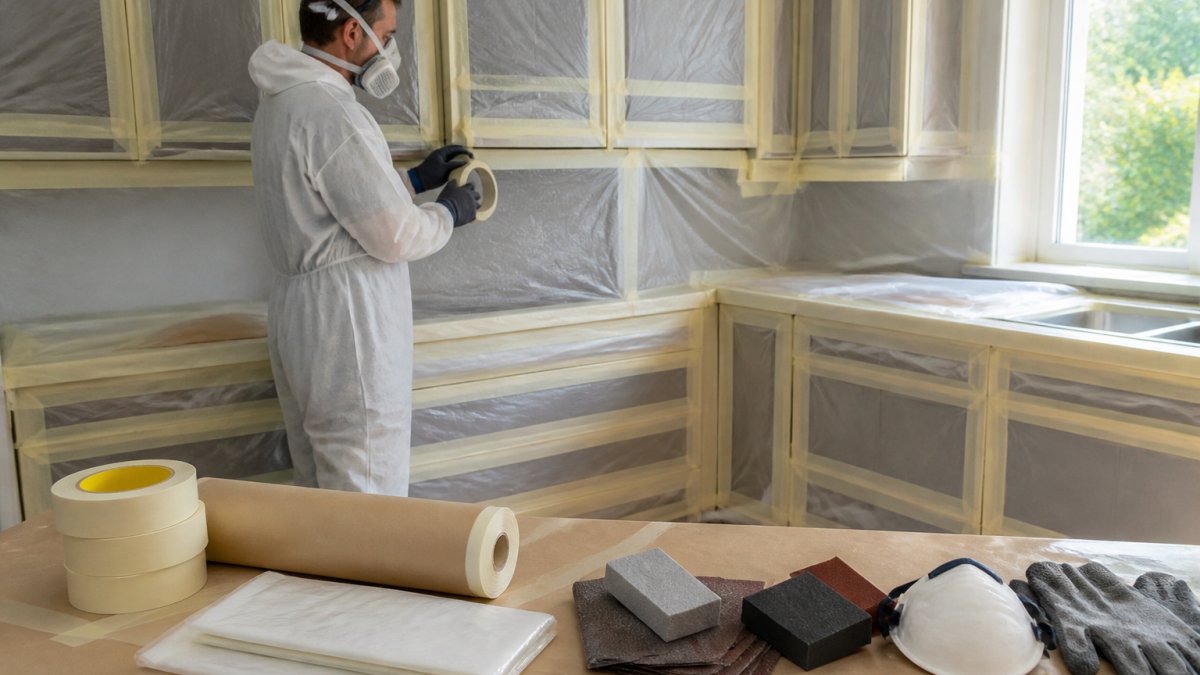
    6. Mask worktops, appliances, floors and walls with sheeting and tape
    7. Apply primer and allow it to cure
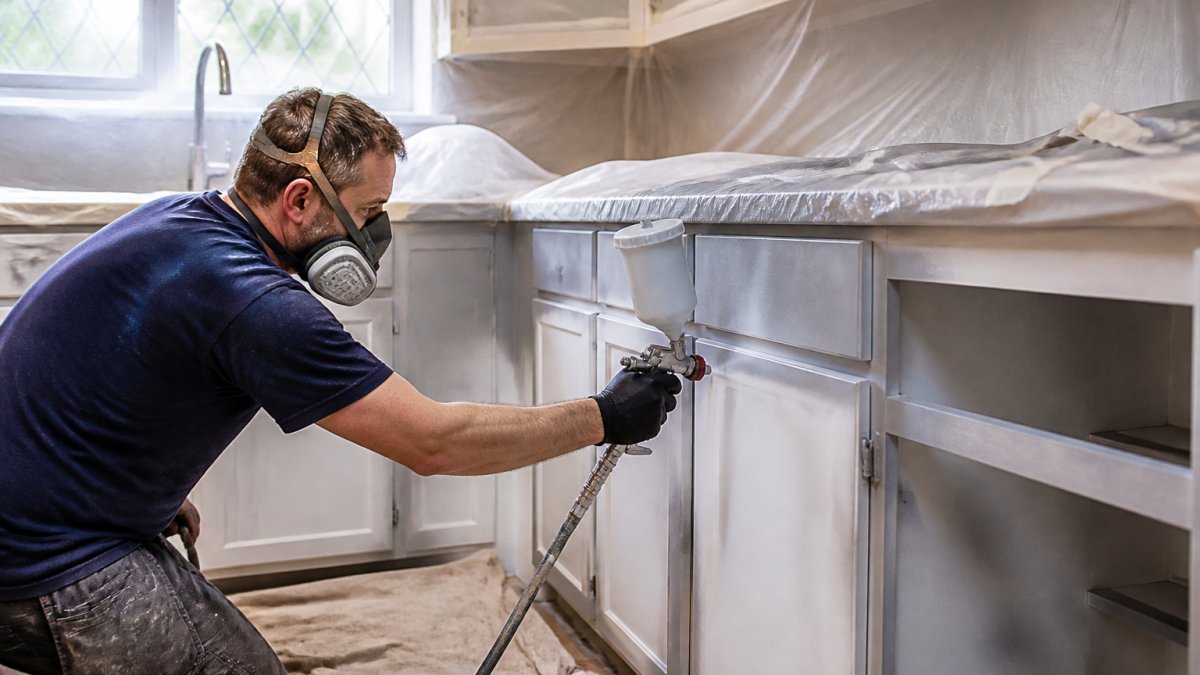
    8. Spray the topcoat in thin, even passes
    9. Leave to cure fully before refitting
    Professional masking kitchen cabinets with protective tape for high-quality cabinet spray painting.
    Professional masking kitchen cabinets with protective tape for high-quality cabinet spray painting.

    Watch out: the most common mistake is spraying over a surface that looks clean but still carries a film of cooking grease. The finish will feel solid at first, then lift at the edges within a season.

    Spray Painting vs Hand Painting Kitchen Cabinets

    Spraying and hand painting suit different jobs, and neither is universally better. Spraying gives a smooth, even, factory-quality finish with no brush marks, which is why it’s the usual choice for flat cabinet doors and cupboards. Hand painting works well for small touch-ups, awkward shapes and period details where a brush can reach what a spray gun can’t.

    Here’s the practical comparison:

    Contact us on WhatsApp →

    Factor Spray Painting Hand Painting
    Finish quality Smooth, even, factory-quality Can show brush marks
    Speed on large areas Fast and consistent Slower, more labour
    Best for Flat doors, full kitchens Touch-ups, intricate mouldings
    Disruption Requires masking and protection Less setup, more drying between coats
    Durability Hard, even coating film Depends heavily on technique

    The trade-off is disruption. Spraying needs proper masking to protect worktops and appliances, which is why many homeowners bring in a professional rather than tackle it themselves.

    Curing Time and When You Can Use Your Kitchen Again

    Most sprayed cabinet finishes are touch-dry within a few hours but need several days to cure fully. Curing is not drying: the solvent leaves the film relatively quickly, but the coating continues to harden through cross-linking over days and sometimes weeks. Handling doors too early can leave marks, soft spots or print transfer from fingers, and cleaning too soon can dull the sheen permanently.

    A practical timeline most professional finishers work to looks like this:

    • Touch-dry: within two to four hours of the final coat, depending on temperature and airflow
    • Light handling (edges only): after the finish resists a gentle fingernail press without indenting
    • Refitting doors and drawers: typically 24 to 48 hours after spraying, once the film has hardened enough to take hinges and handles without marking
    • Full cure: commonly five to seven days, longer in cool or damp conditions or where the coating is a two-pack product that cures by chemical reaction rather than evaporation
    • Normal use: once fully cured, with gentle cleaning for the first week or two
    Watch Out
    Do not refit doors or rehang drawers simply because the surface feels dry to the touch. A finish that is dry but not cured will still mark under a fingernail and can bond to adjacent surfaces if the doors are closed too soon.

    The practical implications matter more than the exact hours. Keep the kitchen well ventilated during the curing window, avoid using the hob at full heat directly beneath freshly sprayed units, and resist the urge to wipe down surfaces with anything stronger than a damp cloth. Grease and steam are the enemies of a finish that has not yet fully hardened.

    Key Takeaway
    Treat the first week as part of the job, not an inconvenience after it. A little patience during curing protects years of finish.

    How to Clean Spray-Painted Kitchen Cabinets

    Cleaning spray-painted cabinets is simple if you use the right products. A soft cloth, warm water and a mild washing-up liquid handle most everyday marks. Wipe with the grain and dry afterwards to avoid water sitting on the surface.

    Avoid these:

    • Abrasive pads and scouring sponges
    • Bleach-based or solvent-heavy cleaners
    • Spray-on degreasers left to sit
    • Scrubbing at edges where the film is thinnest

    For greasy areas near the hob, a diluted mild degreaser on a soft cloth is enough. Rinse and dry. A Primal Cabinet Painting’s guide to painted cabinet lifespan notes that durability depends on the coating and preparation method, and the same logic applies to care: gentle, consistent cleaning protects the finish.

    Diagnosing and Repairing Common Finish Failures

    Failures usually have a clear cause, and most trace back to preparation or use. Anecdotal reports on forums such as Reddit discussion on painted cabinet regrets describe improperly painted cabinets chipping, which points to workmanship rather than the idea of spraying itself.

    Symptom Likely Cause Fix
    Peeling at edges Poor degreasing or missing primer Sand back, re-prime, re-spray
    Chipping on corners Thin coating or heavy impact Touch up with matching coating
    Cracking Coating applied too thick Sand back and recoat evenly
    Fading or discolouration Sun exposure or harsh cleaners Clean gently, consider a refresh coat
    Sticky or soft patches Incomplete curing Allow more cure time, avoid early cleaning

    Small chips can be touched up. Widespread peeling means the bond failed and the panel needs stripping and redoing.

    Is a Professional Respray Right for Your Kitchen?

    A professional respray makes sense when you want a durable, even finish without replacing sound cabinets. You can browse our kitchens service and options to book. It can be a cost-effective alternative to a full renovation, and it keeps disruption lower than ripping out a kitchen. Use our visualiser to see how your kitchen could look before committing. It is less suitable if your cabinet boxes are swollen, water-damaged or structurally failing; in that case, repair or replacement comes first.

    When choosing a finisher, ask them to explain in plain terms what any guarantee covers and what it excludes. Ask for the exclusions in writing before you book.

    A proper job should include:

    • Full masking to protect worktops, appliances, floors and walls
    • A documented multi-step process, not a single quick coat
    Pro Tip
    Ask any finisher three questions before booking: how many coats they apply, what primer they use on your cabinet material, and what their guarantee excludes. The answers tell you more than any glossy brochure.

    To find out more, contact us on WhatsApp.

    Frequently Asked Questions

    Is spray painting kitchen cabinets a good idea?

    Yes, for most sound cabinet boxes. A professional sprayed finish gives a smooth, factory-style result that hand painting struggles to match, and it costs far less than replacement. The catch is that longevity depends on preparation, coating quality and how the cabinets are used.

    What are the downsides of spray painting kitchen cabinets?

    The main downsides are disruption and the need for thorough masking, because overspray can reach worktops and appliances if surfaces are not protected. You also cannot use the kitchen while the coating cures. Poorly executed work can chip, so workmanship matters as much as the paint. Finally, spray painting will not fix swollen or damaged cabinet boxes, so it suits sound carcasses rather than failing ones.

    Can spray-painted kitchen cabinets be touched up if they chip?

    Small chips can usually be touched up, but the result depends on the coating and colour match. A professional finisher can often supply matching paint and advise on the best repair method. Catching chips early prevents moisture getting under the finish and causing peeling. If chipping is widespread, it usually points to poor adhesion from inadequate preparation, and a localised repair may not be enough.

    How does spray painting compare with hand painting kitchen cabinets for durability?

    Spray painting generally gives a more even, factory-quality finish with fewer brush marks, and the consistent coating thickness helps durability. Hand painting can work well but is more prone to visible texture and uneven coverage. In both cases, durability comes down to degreasing, sanding, priming and using a suitable coating. A sprayed finish applied over properly prepared surfaces is the more reliable route to a long-lasting result.

  • How Long Do Kitchen Spray Finishes Last

    How Long Do Kitchen Spray Finishes Last

    Table of Contents

    Last Updated: September 29, 2026

    How Long Kitchen Spray Finishes Last

    Kitchen spray finishes typically last between 7 and 10 years with proper care and maintenance, though this timeline varies significantly based on application quality and environmental factors. A professionally applied kitchen spray finish can maintain its appearance and durability well beyond a decade if the underlying preparation work meets industry standards and the kitchen environment remains reasonably controlled.

    The longevity of kitchen spray finishes depends far more on how they’re applied than on the paint itself. Homeowners often underestimate the impact of surface preparation; a rushed sanding job or inadequate primer application can cut the finish lifespan in half, regardless of the coating quality. The difference between a finish that lasts five years and one that lasts twelve often comes down to decisions made before the spray gun is even picked up.

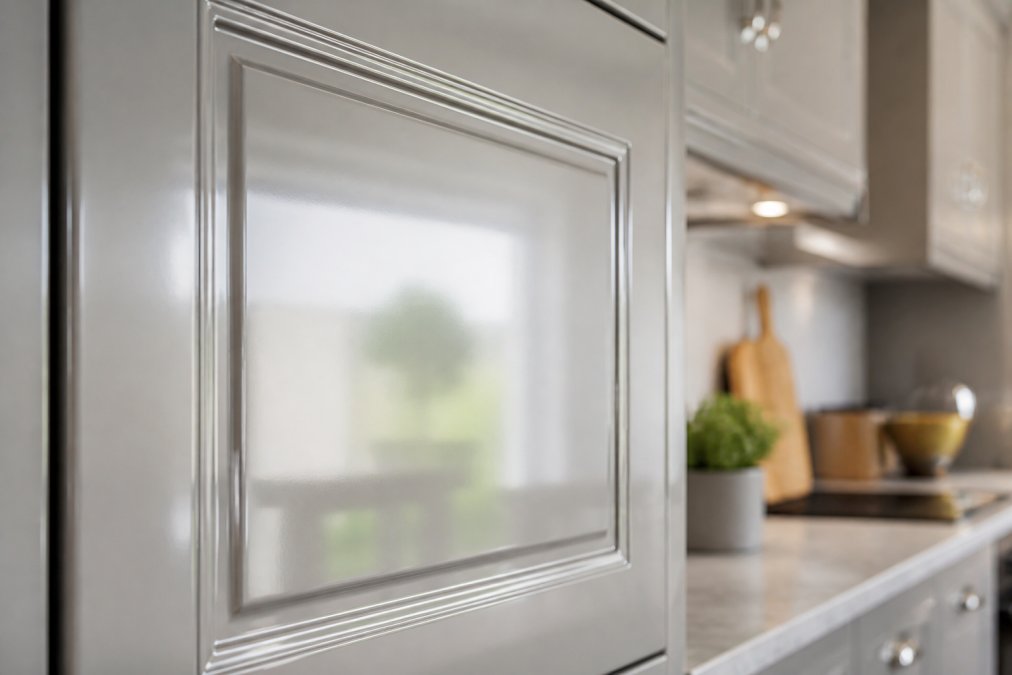
    Close-up of a freshly sprayed kitchen cabinet door showing smooth, professional glossy finish with even colour distribution and light reflecting uniformly across the surface
    Close-up of a freshly sprayed kitchen cabinet door showing smooth, professional glossy finish with even colour distribution and light reflecting uniformly across the surface

    Most kitchen spray finishes fail not because the paint degrades, but because moisture penetrates the coating or adhesion breaks down under daily wear. Understanding what actually determines durability helps homeowners make informed decisions about whether professional spraying makes financial sense for their situation.

    Pro Tip
    The three-step spraying process used by professional applicators, primer, base coat, and topcoat, isn’t just about aesthetics. Each layer serves a specific durability function. The primer bonds to the substrate, the base coat provides colour and coverage, and the topcoat protects against moisture and UV damage. Skipping any step or applying them too thin directly reduces lifespan.

    Factors That Affect Kitchen Spray Finish Durability

    Several interconnected variables determine how long your kitchen spray finish will remain intact and visually appealing. These aren’t minor considerations, each one can add or subtract years from the finish’s effective lifespan.

    Surface Preparation Quality

    The condition of the surface before spraying is the single most critical factor in finish longevity. Cabinets with old varnish, grease buildup, or uneven surfaces create adhesion problems that emerge within months, not years. Proper preparation involves thorough cleaning, sanding to bare wood or a sound substrate, and filling any gaps or damage.

    When preparation is rushed, the new finish sits on top of a compromised surface. Moisture finds its way underneath. Paint begins to peel or blister. What should have been a decade-long finish becomes a three-year problem. Professional applicators spend as much time preparing as they do spraying, sometimes more, because they know this determines everything.

    Dust contamination during application also matters more than many people realise. A single particle embedded in the wet spray can become a point where moisture enters and adhesion fails. Professional spray environments use containment measures specifically to prevent this. Home DIY attempts rarely account for dust settling mid-application, which explains why many amateur spray jobs deteriorate faster.

    Coating Thickness and Application Method

    Spray application allows for precise, even coating thickness, typically 75-125 microns per coat depending on the product. Brush or roller application cannot achieve this consistency, which is why spray-finished cabinets generally outlast hand-painted ones. The uniform thickness means no thin spots where the coating is vulnerable.

    Application method also affects how well the coating bonds to the substrate. Spray creates a better mechanical bond through atomisation, whereas brushing can leave drag marks and uneven adhesion. This structural difference translates directly into durability, spray finishes resist moisture penetration more effectively because there are no brush stroke valleys where water can collect.

    Multiple thin coats outperform a single thick coat. A professional three-coat system distributes the total film thickness across layers that cure properly, whereas one thick coat may not cure evenly throughout its depth. This layering approach is why professional kitchen spray finishes last longer than single-coat alternatives.

    Kitchen Environment and Moisture Exposure

    Kitchens present unique durability challenges because they combine heat, humidity, and moisture in ways few other rooms do. Steam from cooking, splashes from washing up, and ambient humidity all attack paint finishes. Cabinets directly above the hob or sink face accelerated degradation compared to those in drier zones.

    Ventilation quality dramatically affects finish lifespan. A kitchen with effective extraction that removes steam quickly protects the finish far better than one where humidity lingers. Poor ventilation can reduce finish durability by 40-50% simply because moisture has more time to penetrate the coating and reach the substrate.

    Temperature fluctuations also matter. Cabinets that experience significant seasonal temperature swings or daily heating cycles expand and contract, creating stress on the coating. This movement eventually causes cracking and peeling. Kitchens with stable temperatures maintain finishes better than those with dramatic variations.

    Benefits of Professional Kitchen Cabinet Spraying

    Professional spraying offers durability advantages that extend beyond the initial aesthetic appeal. The investment typically pays for itself through the extended lifespan of the finish and the superior appearance it maintains over time.

    The primary benefit is consistency. Professional equipment delivers uniform coating thickness across every cabinet, every door, and every surface. This uniformity means no weak spots, no thin areas that fail early, and no variation in colour or sheen. Homeowners attempting spray finishing rarely achieve this level of consistency without significant experience.

    Astral Coatings Ltd. employs a meticulous three-step spraying process that addresses both immediate appearance and long-term durability. This methodical approach takes longer than a quick spray job, but the finish lasts significantly longer as a result.

    Contact us on WhatsApp →

    Professional applicators also protect your kitchen during the process. Proper masking prevents overspray on worktops, appliances, and flooring. This attention to detail means you don’t face the choice between accepting spray damage or paying for repairs. The surrounding environment remains protected throughout the work.

    Key Takeaway
    The real cost comparison isn’t between professional spraying and DIY. When you factor in the cost of respraying cabinets that failed prematurely, professional application often proves more economical over a longer period.

    Maintenance Tips to Extend Your Spray Finish Lifespan

    How you care for spray-finished cabinets after application determines whether they reach their full potential lifespan. Proper maintenance can extend a finish by several years, while neglect can cut it short.

    Clean cabinets regularly with a soft, damp cloth and mild detergent. Avoid abrasive scrubbers or harsh chemicals that can damage the topcoat. Grease and food residue should be removed promptly because they can degrade the finish over time. This doesn’t require special products, warm soapy water works effectively.

    Wipe up spills immediately, particularly around the hob and sink where moisture exposure is highest. Water sitting on the finish seeps into micro-cracks and compromises adhesion. Quick drying prevents this damage. Similarly, ensure good ventilation during and after cooking to reduce humidity exposure.

    Avoid placing hot items directly on cabinet surfaces. Extreme heat can soften or damage the topcoat. Use trivets or protective mats for pans and hot cookware. This simple precaution prevents localised damage that can become entry points for moisture.

    Inspect cabinets periodically for signs of wear. Small chips or cracks should be touched up promptly before moisture penetrates deeper. Most professional applicators can provide matching paint for minor repairs. Addressing damage early prevents it from spreading.

    How to Clean Spray Painted Kitchen Cabinets

    Cleaning spray-painted cabinets differs slightly from cleaning other surfaces because the finish is more delicate than solid wood and requires gentler care. Understanding proper cleaning technique protects your investment.

    Use a microfibre cloth or soft cotton cloth rather than paper towels, which can be abrasive. Dampen the cloth with warm water and add a drop of mild washing-up liquid. Wring out excess water so the cloth is damp, not wet. Excess water sitting on the finish can cause damage.

    Wipe cabinets in the direction of the grain (if applicable) or in gentle circular motions. This approach removes dust and light grime without creating visible swirl marks. For stubborn marks or grease buildup, slightly increase the concentration of washing-up liquid, but avoid strong degreasers or bleach-based cleaners that can strip the topcoat.

    Dry cabinets immediately after cleaning with a separate dry cloth.

    Watch Out
    Never use scouring pads, wire brushes, or abrasive cleaners on spray-finished cabinets. These tools can scratch or dull the topcoat, creating visible damage and potential entry points for moisture. Even “gentle” abrasive pads can harm the finish.

    Understanding Kitchen Cabinet Spraying Cost and Value

    The cost of professional kitchen cabinet spraying varies based on the number of cabinets, complexity of the layout, and current condition of the surfaces. Rather than stating specific prices, which depend on individual project scope, the value proposition becomes clear when you compare the total cost of ownership over time.

    Signs Your Kitchen Spray Finish Needs Refreshing

    Even well-maintained spray finishes eventually show signs of wear. Recognising these indicators helps you plan for refresh work before the finish deteriorates significantly.


    Frequently Asked Questions

    How many years does a professional kitchen spray finish typically last?

    Professional kitchen spray finishes generally last 7-10 years with proper maintenance. The lifespan depends on how well the surface was prepared before spraying, the quality of the coating applied, and how much moisture and wear your kitchen experiences. Homes with good ventilation and regular cleaning see finishes last towards the upper end of this range. Professional application ensures optimal coating thickness, which significantly extends durability compared to DIY attempts.

    What factors have the biggest impact on how long kitchen spray finishes last?

    Surface preparation is critical, any dust, grease, or uneven substrate leads to premature peeling. Kitchen moisture and steam exposure also matter greatly; poor ventilation accelerates deterioration. The spraying method itself affects durability; a meticulous multi-step process applies even coating thickness, whereas single-pass spraying often results in thin, vulnerable finishes. Finally, your maintenance routine, regular gentle cleaning and avoiding abrasive scrubbing, directly influences how long the finish remains intact and attractive.

    Does professional spray painting last longer than hand painting kitchen cabinets?

    Yes, professional spray application produces more durable finishes. Spray methods deliver consistent, even coating thickness across all surfaces, including hard-to-reach areas inside cabinet frames. Hand painting often leaves visible brushstrokes, uneven coverage, and thinner layers that chip more easily. Professional sprayers also use industrial-grade equipment and follow rigorous preparation protocols that hand painters typically skip, resulting in better adhesion and longer-lasting colour and protection.

    How can I tell if my kitchen cabinets need respraying?

    Watch for peeling, flaking, or chipping paint, especially around handles and high-touch areas. Dull or discoloured patches suggest the finish is wearing through. If cabinets feel sticky or tacky to the touch, the topcoat is breaking down. Visible brush marks or uneven sheen also indicate the finish is failing. If your spray finish is approaching 7-10 years old and showing any of these signs, respraying will restore both appearance and protection. A professional inspection can confirm whether refinishing is needed.