Last Updated: November 1, 2026
Quick Summary
Spray finishing gives exterior doors an even, factory-style film with no brush marks, consistent coverage and fewer drips than brushing. It is the fastest route to a uniform surface, though preparation, masking and the right exterior coating system decide how long it lasts.
- Spraying wins on finish quality and speed; brushing suits small repairs and touch-ups.
- Poor preparation stops a new coat bonding, whatever coating brand you use.
- Inspect edges and the base rail annually and touch in defects early.
- A single exterior door usually takes more than one day across preparation, spraying and curing.
- Spraying is unsuitable for rotten, delaminating or structurally failing doors.
Table of Contents
- What Spray Finishing Actually Delivers on an Exterior Door
- Spray Finish vs Brush Painting Doors: A Practical Comparison
- Exterior Door Preparation for Painting: Why It Decides the Result
- Durability of Spray-Painted Doors: What Affects How Long It Lasts
- Spray Painting uPVC Doors: What Works and What Doesn’t
- Realistic Costs, Timelines and When Spraying Is Unsuitable
- Arranging a Spray Finish for Your Exterior Door
- Frequently Asked Questions
What Spray Finishing Actually Delivers on an Exterior Door
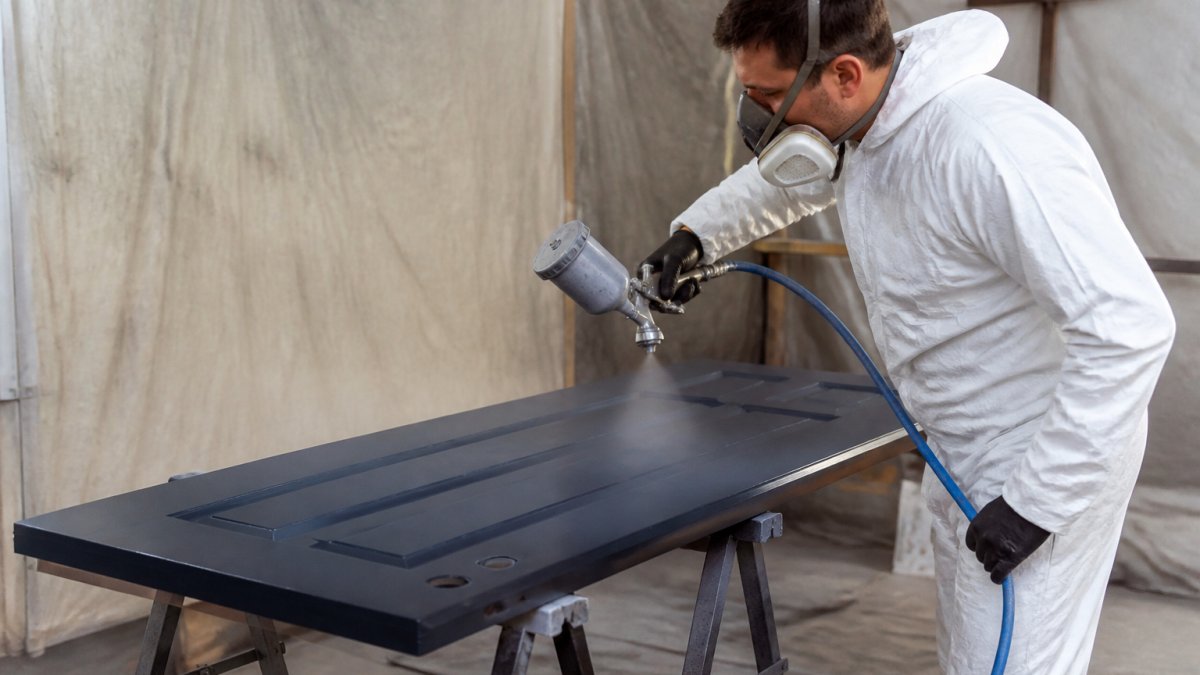
Spray finishing is the application of coatings through a spray gun rather than a brush or roller, and it remains the fastest route to a uniform, factory-style surface on an exterior door.
Painted finishes continue to lead the front-door market, according to Window + Door’s front door trends coverage, largely because homeowners want to personalise appearance and kerb appeal. A spray finish is the most reliable way to get that colour onto the door cleanly.
A Smooth, Factory-Style Finish
The biggest draw is the surface itself. A sprayed coating lands as a fine, even mist that levels out into a continuous film. No bristle lines, no lap marks where a brush was reloaded, no stipple from a roller sleeve.
If you want to picture how a sprayed surface reads on a real property, our visualiser lets you see the finish before any work starts.
Even Coverage and Fewer Drips
Spray application can put down a consistent film across flat panels, mouldings and edges, with less risk of runs and sags when the equipment is correctly set up. That consistency is also what protects the door: an even coat weathers evenly, so you do not get patchy breakdown around the base rail or the lock stile.
Spray Finish vs Brush Painting Doors: A Practical Comparison
Spray finishing wins on finish quality and speed; brushing wins on setup simplicity and small touch-ups. That is the honest summary. A spray finish vs brush painting doors comparison really comes down to how much surface you are coating and how visible the result will be.
| Factor | Spray finish | Brush and roller |
|---|---|---|
| Surface quality | Smooth, factory-style film | Visible texture and brush marks |
| Speed on a full door | Fast, both faces in one session | Slower, especially on mouldings |
| Setup required | Masking and containment | Minimal |
| Overspray risk | High without containment | None |
| Best for | Full doors, frames, multiple doors | Small repairs and touch-ups |
Brushing and rolling still have a place: a scuffed edge or a small repair is quicker to touch in by hand. For a whole door, though, the labour and the finish quality both favour spray.
Exterior Door Preparation for Painting: Why It Decides the Result
Preparation decides whether a spray finish lasts or fails, and on an exterior door it matters more than the coating brand.
Our spraying process follows a meticulous three-step routine. Preparation comes first, and in practice that means:
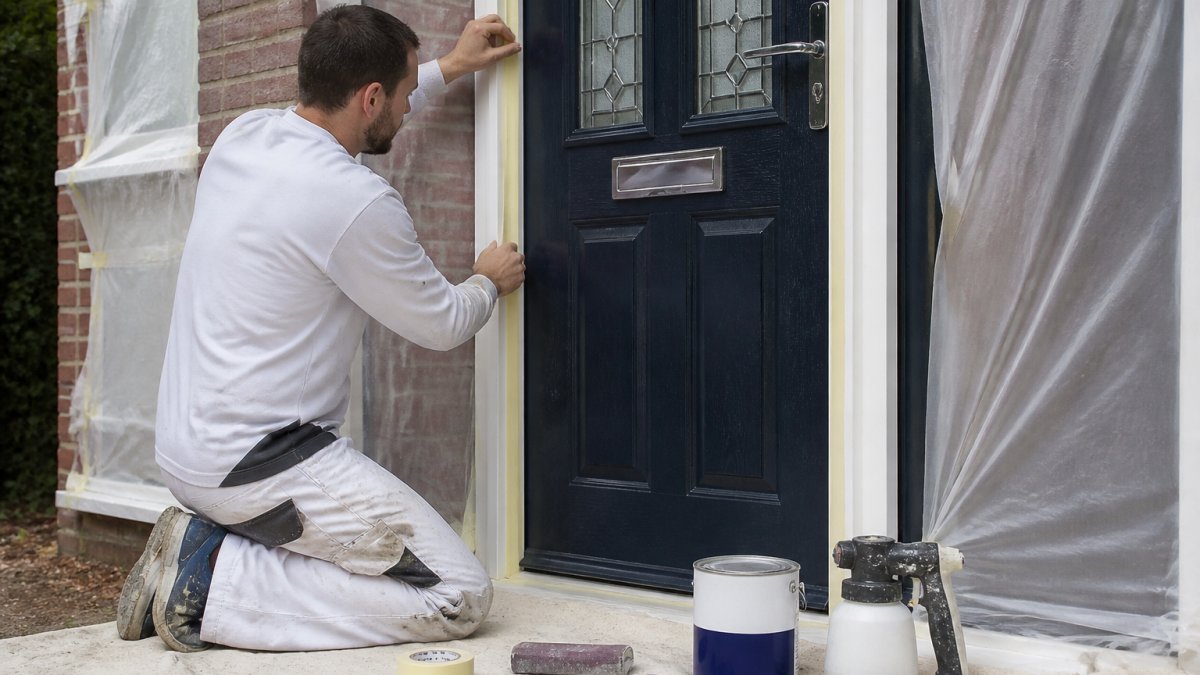
If you want to see how preparation and masking work in a real spraying job, our step-by-step uPVC spraying guide walks through the process from start to finish.
Watch out: spraying without proper masking can put a fine coating mist onto glass, handles and neighbouring surfaces, and cured overspray is far harder to remove than wet paint.
Durability of Spray-Painted Doors: What Affects How Long It Lasts
Durability of spray-painted doors depends on the coating system, the material underneath, and how much weather the door actually faces. A sprayed finish is not automatically tougher than a brushed one. Woodworkers Journal’s guidance on exterior finishes makes the point clearly: UV light, summer heat and moisture all attack exterior coatings, and a clear finish that lets UV through will degrade faster than one that blocks it.
The Mechanisms That Break Down an Exterior Finish
Understanding why exterior coatings fail helps explain why some sprayed doors last far longer than others:
- UV degradation. Sunlight breaks down the resin in many coatings, causing chalking, colour fade and a powdery surface. Exterior-rated topcoats include UV blockers or use resins that resist this better than interior paints.
- Moisture ingress and movement. Timber expands and contracts with humidity, and a rigid coating that cannot flex will crack at joints and panel edges. Flexible exterior coatings accommodate that movement.
- Thermal cycling. A south-facing door can get very hot in summer and cold at night, and repeated expansion and contraction stresses the film, especially at edges and mouldings.
- Substrate failure. On steel doors, rust at the base or around fixings will lift any coating. On uPVC, poor adhesion shows up as peeling rather than cracking.
- Film thickness and edge coverage. Thin films and poorly covered edges are where breakdown starts. A sprayed finish applied at the correct thickness gives even protection, but edges and the base rail still need proper coverage.
Maintenance and Expected Service Life
How long a sprayed exterior door lasts is not a single number. A well-applied exterior system on a sound door in a sheltered position generally lasts longer than a poorly prepared one. Our Warranty & Aftercare page sets out the support that comes with a spray finish.
Maintenance that can extend service life:
- Clean regularly. Wash the door with a mild detergent and water to remove dirt, pollution and bird droppings, which hold moisture against the coating. Avoid abrasive cleaners that dull the finish.
- Check edges and the base. The bottom rail and edges take the most weather. Inspect them annually and touch in any small defects before water gets behind the film.
- Touch up promptly. Small chips or scratches can be touched in by hand to limit moisture reaching the substrate.
- Recoat before failure. When the surface starts to dull or chalk consistently, a fresh coat restores protection. Recoating before the old film breaks down is far cheaper than stripping back.
- Address movement and hardware. Loose hinges, swollen timber or failed seals let water in, and no coating will compensate for that.
A south-facing door with no porch will always need more attention than a sheltered one, and a door in a coastal or exposed position will need more frequent inspection.
Spraying gives an even film, but longevity comes from the coating system, the preparation underneath and routine maintenance. Inspect edges and the base rail annually and touch in defects early.
Spray Painting uPVC Doors: What Works and What Doesn’t
Spray painting uPVC doors depends on the surface being properly prepared and coated with a product suited to plastic, and adhesion is the key factor.
If your property has uPVC doors, windows or a conservatory that have faded or yellowed, we can advise on what a spray finish can do for them. You can also explore our UPVC Exteriors service to see what it covers.
Realistic Costs, Timelines and When Spraying Is Unsuitable
Costs vary with the number of doors, their condition and how much masking and preparation is needed, so we recommend contacting us on WhatsApp for a quote on your project. That said, it helps to understand what drives the price and how long a typical exterior door project takes, so you can plan realistically.
What Drives the Cost of Spray Finishing an Exterior Door
A spray finish on a single exterior door is rarely a like-for-like quote between contractors because the variables are significant:
- Preparation and repair. Stripping back flaking coatings, filling defects and spot-priming bare timber or metal adds labour. A door in poor condition can take as long to prepare as to spray.
- Masking and containment. An exterior door usually means masking glass, furniture, thresholds, adjacent walls and sometimes erecting sheeting to contain overspray. More surrounding surfaces means more time.
- Coating system. Exterior-rated primers and topcoats cost more than standard interior paints, and a uPVC-specific system costs more again. The number of coats specified also affects material cost.
- Access and height. A door at ground level with clear access is quicker to set up for than one above a porch or behind established planting.
- Number of doors. A single door carries a higher per-door setup cost than a set of frames or a run of doors sprayed in one visit.
We price each job after seeing the condition, the material and the masking required, so please contact us for a quote.
Timelines: From Preparation to Cure
A realistic timeline for a single exterior door usually runs across more than one day because preparation, spraying and curing are separate stages:
- Preparation and masking, washing, degreasing, sanding, filling and masking. This is often the longest stage and can take the better part of a day on a weathered door.
- Priming and spot-priming, bare areas and repairs need primer, which must dry before the topcoat.
- Spray application, the actual spraying of a single door is quick, often a matter of hours including both faces and edges, but it depends on the number of coats and the coating’s recoat times.
- Drying and curing, the door can usually be handled sooner than it can be fully closed and locked, and full cure takes longer. Exterior coatings generally need to be protected from rain and heavy dew until they are touch-dry, and some need longer before they reach full hardness.
Weather can affect drying times, as cool, damp or windy conditions can slow drying and affect how the film flows.
When Spraying Is the Wrong Choice
Spraying is unsuitable in a few situations, and it is better to know them up front:
- The door is rotten, delaminating or structurally failing. A coating will not fix that.
- The existing coating is blistering across large areas and needs stripping first.
- The door is in an enclosed space with no way to contain overspray and protect nearby surfaces.
- Weather conditions are wrong and there is no controlled environment to work in.
In those cases, the honest answer is repair or replacement, not a spray finish.
If you are comparing quotes, ask what preparation and masking are included. A low quote that assumes minimal preparation can end up costing more once the door is assessed.
Arranging a Spray Finish for Your Exterior Door
A spray finish is worth it when the door is sound and the surface matters to you. The benefits of spray finishing exterior doors are real: a smooth, factory-style film, even coverage, fewer defects and a quicker job than brushing.
To arrange a spray finish on your exterior door, get in touch with our team. You can find out more about us and how we work across the area, then message us on WhatsApp to book a visit and a quote.
Frequently Asked Questions
Is spray finishing better than brush painting for an exterior door?
Spray finishing can give a smooth, even finish with fewer brush marks or roller texture than traditional painting methods. The right approach depends on the project, so please contact us to discuss your door.
How durable is a spray finish on an exterior door?
The durability of spray-painted doors depends on the coating system, the preparation and the door material, not on spraying alone. Durability depends on the coating system, the preparation and the door material, and exterior-grade products with UV protection and weather resistance are designed for outdoor exposure. Clear varnish alone lets UV light through, so choose a finish formulated for exterior exposure and expect to inspect it periodically.
Can uPVC and composite exterior doors be spray finished?
Yes, both can be spray finished, but they need different preparation. uPVC should be cleaned and keyed so the coating grips, and the right primer matters because some plastics resist paint. Composite doors can be finished in a range of colours, and the suitability of a spray finish depends on the door’s condition. On either material, spray painting uPVC doors works best when the surface is sound and free of damage.
How long does it take to spray finish an exterior door?
Preparation often takes a significant part of the overall time, and drying and curing between coats also affect the schedule. For an estimate of timing on your door, please contact us.
The finish on your front door is the first thing anyone notices about your property. If your door is sound but tired, sprayed, our team can bring it back to a clean, even, weather-ready surface. Get started with Astral Coatings Ltd. and arrange a spray finish for your exterior door.
