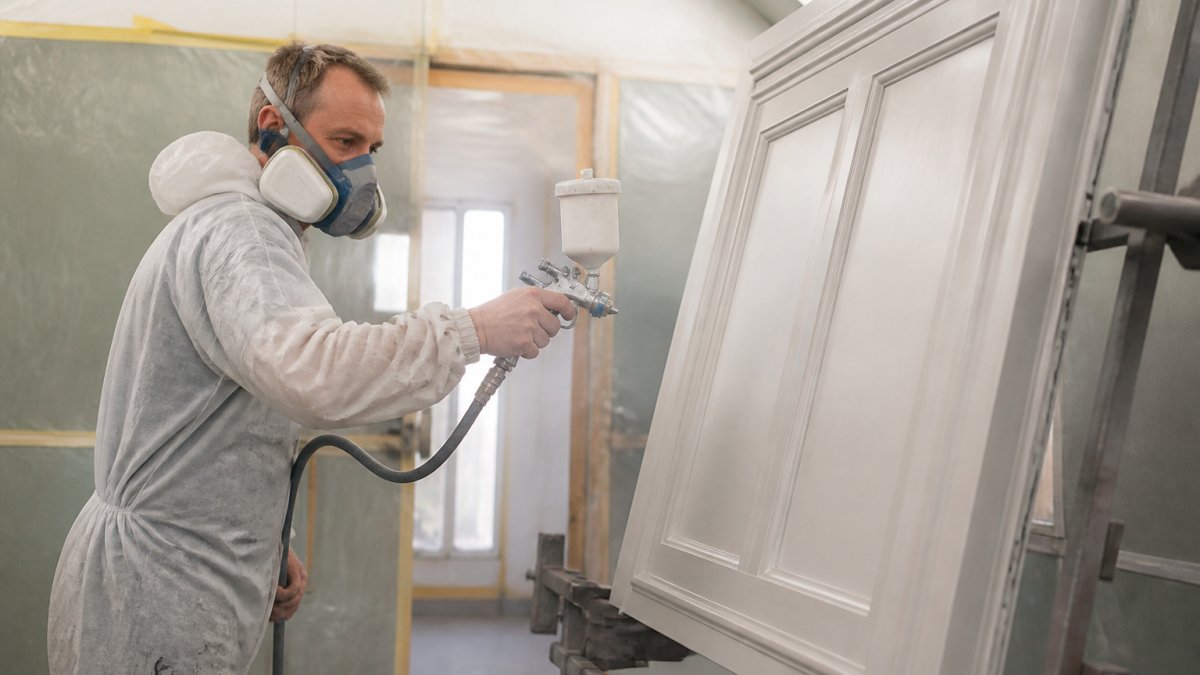
Table of Contents
- What Residential Spray Finishing Offers
- Kitchen Cabinet Spray Finishing Benefits
- uPVC Window Spray Painting Cost and Value
- Professional Spray Painting vs Hand Painting
- The Three-Step Spray Finishing Process
- Minimising Disruption During Application
- How to Get a Quote for Your Project
- Frequently Asked Questions
Last Updated: September 28, 2026
What Residential Spray Finishing Offers
Residential spray finishing services apply professional-grade coatings to interior and exterior surfaces using precision spray equipment, delivering a smooth, durable finish without the cost of full replacement or renovation. This approach transforms worn kitchens, faded uPVC windows, doors, and conservatories into refreshed spaces that look factory-fresh. Astral Coatings Ltd. helps homeowners achieve high-quality results by spraying existing fixtures instead of replacing them entirely.
The core appeal lies in the durability and aesthetic quality. Spray-applied coatings bond uniformly across surfaces, creating a finish that hand painting simply cannot match. Unlike brush or roller application, spray finishing eliminates brush marks, drips, and uneven coverage. The process also allows for optimal coating thickness, which directly impacts how long the finish will withstand daily wear, weathering, and UV exposure.
What makes residential spray finishing particularly valuable is the speed and minimal disruption. A kitchen cabinet refresh that might take weeks with traditional painting can be completed in days with spray finishing. The finish dries faster, cures quicker, and homeowners can return to normal use sooner. For busy households or those working from home, this matters significantly.
The durability difference is measurable. Properly sprayed finishes on kitchen cabinets can outlast hand-painted ones because the coating thickness is consistent and the adhesion is superior. This is why professional spray finishing delivers results that justify the investment.
Kitchen Cabinet Spray Finishing Benefits
Kitchen cabinets are the most visible target for spray finishing, and the benefits here are substantial. A sprayed cabinet finish provides a factory-quality appearance that transforms the entire kitchen aesthetic without the disruption, cost, or waste of a full cabinet replacement. Homeowners often hesitate between refreshing existing cabinets or buying new ones, and spray finishing makes the former genuinely competitive.
The finish quality is the primary advantage. Spray application creates a smooth, glass-like surface free of brush marks or texture variation. This uniformity catches light evenly, making the kitchen feel more polished and contemporary. The visual difference between a hand-painted cabinet and a professionally sprayed one can be significant, with the sprayed finish often looking more refined.
Durability in the kitchen environment is critical. Cabinets face heat from cooking, moisture from washing up, and constant handling. A properly applied spray finish resists chipping, peeling, and wear better than hand-applied coatings. The kitchen cabinet spray finishing benefits extend to colour stability as well; professional coatings can resist yellowing and fading.
Cost efficiency is another genuine benefit. Replacing a full kitchen can be a significant investment. Spray finishing the existing cabinets costs a fraction of that while delivering a genuinely renewed look. For homeowners wanting to refresh their space without a major renovation budget, this is often a decisive factor.
uPVC Window Spray Painting Cost and Value
uPVC windows, doors, and conservatories are excellent candidates for spray finishing, particularly when they’ve faded, yellowed, or developed that tired, weathered appearance that characterises older installations. The uPVC window spray painting cost comparison is straightforward: replacement can be a significant investment per window or door, whilst spray finishing costs substantially less whilst delivering a restored appearance.
The value proposition centres on restoring factory-fresh aesthetics without replacement. uPVC can chalk, discolour, and lose its crisp appearance over time depending on sun exposure and maintenance. Replacement means removing frames, disposing of old units, and disrupting the property. Spray finishing simply applies a protective, colour-matched coating that restores the original look.
Weather resistance is a key consideration. Professional spray coatings protect uPVC from further UV degradation and weathering. This protective layer extends the functional life of the frames themselves, not just their appearance. A sprayed uPVC window will resist fading and chalking better than an uncoated, aged frame.
The process works on frames that are structurally sound but visually worn. If the seals are failing, the glass is damaged, or the frames are warped, replacement is necessary. But if the issue is purely cosmetic, fading, discolouration, or a dated appearance, spray finishing restores the property without the expense and disruption of replacement. This distinction matters because many homeowners assume their windows need replacing when they simply need refinishing.
Weathered frames with surface cracks or significant damage may not be suitable for spray finishing alone. The coating will not repair structural issues, it restores appearance on sound frames. Have the frames assessed before committing to the work.
Professional Spray Painting vs Hand Painting
The differences between professional spray finishing and hand painting are substantial enough to justify choosing one over the other based on the specific project. Both methods apply paint, but the results, durability, and finish quality diverge significantly.
Hand painting offers control and precision on small, detailed areas. Trim work, edges, and intricate mouldings are often easier to hand paint without overspray. Hand painting also works well on surfaces that are difficult to mask or protect. However, hand painting is inherently slower, more labour-intensive, and prone to visible brush marks, uneven coverage, and variations in finish thickness.
Professional spray painting delivers uniform coverage, superior finish quality, and faster application. Spray equipment atomises the coating into fine particles, creating a smooth, even layer without brush marks or texture. The coating thickness is consistent across the entire surface, which directly translates to better durability and longevity. Spray finishing is also faster, large surfaces like kitchen cabinets or conservatory frames are completed in a fraction of the time hand painting would require.
The durability difference can be measurable. Hand-painted finishes may show wear within a few years in high-use areas like kitchens. Professionally sprayed finishes, when properly applied, can last longer. The superior adhesion and uniform thickness of spray application account for this difference.
Cost-wise, spray finishing can have higher upfront material and equipment costs, but the speed of application often makes the total labour cost competitive with hand painting, particularly on larger projects. For kitchen cabinets, conservatories, or multiple uPVC frames, spray finishing can deliver better value over the lifetime of the finish.
Choose spray finishing for large, visible surfaces where finish quality and durability matter. Choose hand painting for small detailed areas, tight spaces, or projects where overspray risk is high. Most residential projects benefit from a combination, spray for the main surfaces, hand finishing for edges and details.
The Three-Step Spray Finishing Process
Professional spray finishing follows a disciplined three-step process that distinguishes high-quality work from rushed or amateur efforts. Understanding these steps explains why professional spray finishing costs more than basic painting and why the results justify the investment.
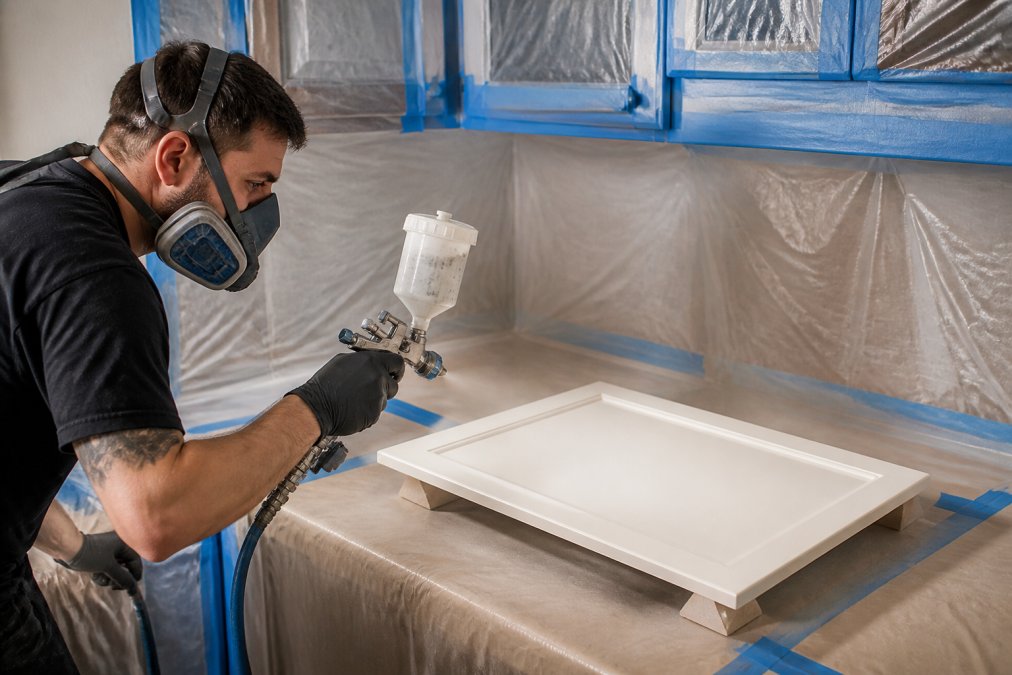
Step One: Surface Preparation and Masking. The foundation of any quality spray finish is meticulous preparation. Surfaces are cleaned, sanded, and degreased to ensure the coating adheres properly. Existing finishes are assessed, some may be lightly sanded to improve adhesion, whilst others require stripping. All surrounding areas are masked with protective coverings to prevent overspray. This step is labour-intensive but absolutely critical. Shortcuts here result in poor adhesion, peeling, and premature failure.
Step Two: Primer and Base Coats. Once surfaces are prepared, a primer is applied to promote adhesion and provide a uniform base. The primer ensures the final colour coat covers evenly and bonds securely. After the primer cures, the first colour coat is applied. Professional spray application uses multiple thin coats rather than one thick coat, this approach ensures even coverage, better adhesion, and superior durability.
Step Three: Final Coat and Curing. The final colour coat is applied once the base coat has cured sufficiently. This coat delivers the finished appearance and colour. After application, the work is left to cure fully, this timeframe varies depending on the coating type and environmental conditions, but typically ranges from 24 to 72 hours before normal use can resume.
The three-step process is what separates professional results from amateur work. Each step builds on the previous one, and skipping or rushing any step compromises the final result. This is why professional spray finishing services command a premium compared to basic painting, the process is thorough, time-consuming, and the quality difference is visible.
Minimising Disruption During Application
Household disruption is a legitimate concern for homeowners, particularly those working from home or with young children. Professional spray finishing is designed to minimise disruption, but understanding what to expect helps households plan accordingly.
Spray equipment generates noise, though modern equipment is quieter than older models. The noise level is comparable to a vacuum cleaner, noticeable but not deafening. Most work occurs during normal business hours, and the duration is measured in hours or a few days rather than weeks.
Dust and overspray are the primary disruption concerns.
How to Get a Quote for Your Project
Getting an accurate quote for residential spray finishing requires providing clear information about the scope of work, the surfaces involved, and the desired outcome. The process is straightforward, but the detail you provide directly impacts the accuracy of the estimate.
Homeowners in West Sussex and the surrounding area wanting to refresh kitchen aesthetics, restore faded uPVC windows and conservatories, or modernise dated interior fixtures without the cost and disruption of full renovation or replacement.
Frequently Asked Questions
How long does a professional spray finish last on kitchen cabinets and exterior surfaces?
A properly applied professional spray finish can last for several years on interior surfaces like kitchen cabinets when maintained correctly. Exterior finishes on uPVC and conservatories can also last for several years depending on weather exposure and maintenance. The durability depends on surface preparation, coating quality, and the three-step application process used by professionals to ensure optimal coating thickness.
What makes professional spray finishing better than DIY or hand painting?
Professional spray finishing delivers uniform coverage, superior finish quality, and faster application compared to hand painting. Professionals control spray patterns, coating thickness, and drying conditions to prevent drips, runs, and uneven colour. They also protect surrounding surfaces systematically, minimising damage risk to worktops and appliances, something difficult to guarantee with DIY methods.
Can spray finishing work on old, weathered uPVC windows and doors?
Yes, weathered uPVC can be spray finished successfully if properly prepared. The surface must be cleaned, sanded, and primed to ensure adhesion. Professional assessment is essential because severely damaged frames may require replacement instead. Professionals evaluate each frame’s condition and recommend the best solution before starting work.
How much disruption should I expect during residential spray finishing?
Spray finishing causes minimal disruption compared to full renovation. Most interior projects take a few days depending on surface area. Dust and odour are controlled through masking and ventilation. You can typically remain in the property, though the sprayed area should be avoided during application and drying. Professionals manage the timeline to minimise inconvenience, particularly for those working from home.